
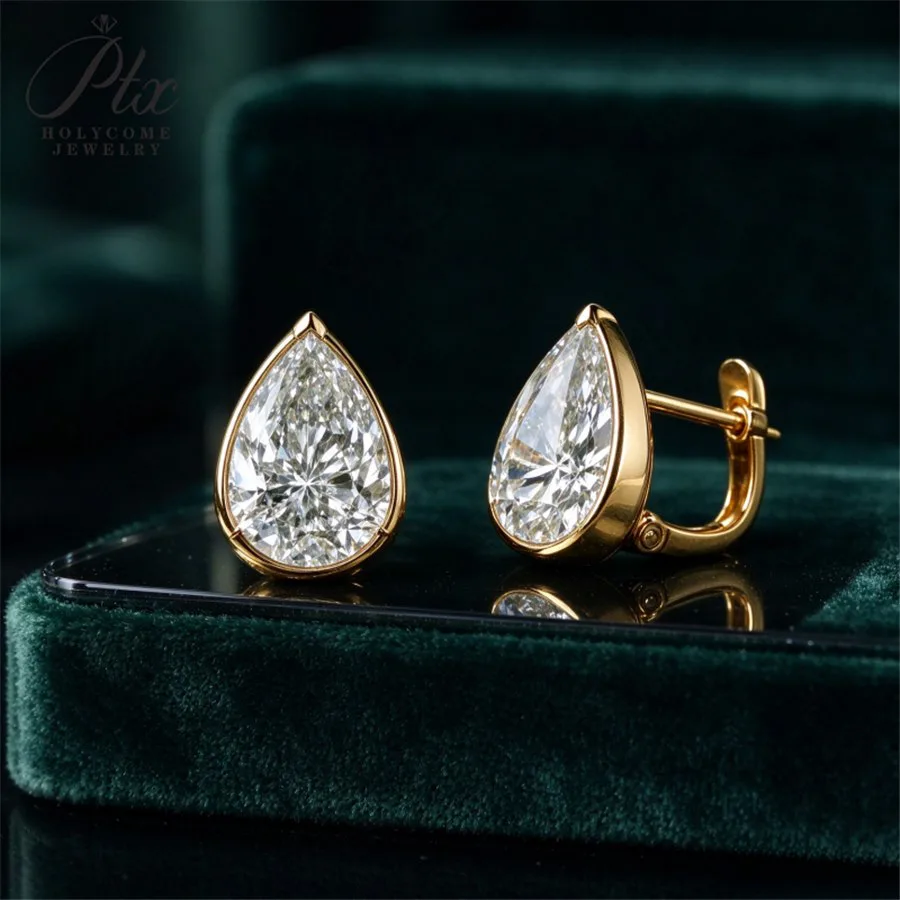
No. Moissanite does not become cloudy, turn yellow, or lose its sparkle with age. Silicon carbide is chemically stable, it does not fade in sunlight, and at 9.25 on the Mohs scale it is harder than every common jewelry stone except diamond. In almost every case we investigate, a stone that went cloudy is dirty, was cleaned with an abrasive, or is sitting in a setting that has tarnished underneath it. For a jewelry brand, knowing the difference is worth real money: a two-minute cleaning conversation is far cheaper than a return, a refund, or a one-star review.
Why moissanite holds its fire
Moissanite is grown as a single crystal of silicon carbide (SiC). That matters for two reasons. First, the material is inert. It does not oxidize, it does not react with soap, sweat, perfume or chlorinated pool water, and it does not develop the milky surface haze that softer stones can pick up after years of wear. Second, its optical performance is built into the crystal, not applied on top of it. The high refractive index (roughly 2.65 to 2.69) and very high dispersion (about 0.104) that produce moissanite fire come from the bulk material. There is no thin film to wear through and no dye to fade under normal jewelry conditions.
In practice, a moissanite that was bright on the day it was set will still be bright years later, provided the stone is not physically abused and the metal around it is maintained.
What actually causes a cloudy moissanite
When a retail partner or an end customer reports cloudiness, we work through the same short list every time. In our experience the cause is nearly always one of these.
| Symptom | Most likely cause | What to do |
|---|---|---|
| Uniform dull film within days of purchase | Hand lotion, sunscreen, hair product or soap residue | Warm water, a drop of mild dish soap, a soft brush, rinse, dry with a lint-free cloth |
| White haze after swimming or showering | Hard-water minerals and soap scum | Same routine; use a commercial jewelry cleaner for stubborn film |
| Stone looks flat in the store, alive at the window | Lighting, not the stone - moissanite fire is strongest in daylight and diffused light | Show the piece near a window before accepting a complaint as a defect |
| Fine scratches across the table | Abrasive paste, toothpaste, or a polishing cloth contaminated with diamond grit | Have the stone re-polished; ban abrasive cleaners at the counter |
| Gray or yellow cast that worsens towards the edge of the stone | Tarnished 925 silver or worn gold plating in the setting beneath the stone | Re-polish or re-plate the setting; inspect prongs and the gallery |
| Dull ring of haze around pave or bezel-set stones | Trapped polishing compound or plating residue from manufacturing | Clean in an ultrasonic with jewelry solution and inspect at 10x before shipping |
| Appearance changes only where a coating was applied | Some suppliers use color or coating treatments to whiten material | Ask your supplier whether the stone is coated, and never use abrasives on coated stones |
Put cleaning into your QC process, not just the care card
- Inspect incoming stones and finished pieces at 10x before packing. Most cloudy on arrival complaints are plating or polishing residue, not the stone.
- Clean every finished piece before it is bagged. It is the single cheapest way to reduce returns.
- Use mild soap, warm water, a soft brush and a lint-free cloth. No toothpaste, no abrasive cream, no ultrasonic solution meant for industrial parts.
- Keep jewelry ultrasonics separate from any other cleaning equipment, and change the solution on schedule.
- Store loose moissanite away from loose diamond melee. A shared tray is how diamond grit ends up on a polishing cloth and how a scratch appears on a stone.
- Include a printed care card with every bulk order so your retail partners pass the message on rather than improvising advice.
What to promise your customers
Promise what the material actually does: moissanite is highly scratch resistant, color stable, and easy to clean. Do not promise that it never needs cleaning, and never describe any stone as unscratchable. If the stone carries a surface coating or treatment, disclose it and warn against abrasive cleaners. Those two sentences protect your brand far more than an absolute claim ever will.
Holycome has manufactured moissanite jewelry for more than 18 years for 100+ clients and ships to 100+ countries. We supply GRA-certified moissanite set in 925 silver and in brass with gold plating from our own 800 sqm plating facility, with 7-day sampling and a 30-day risk-free guarantee. If you want stones and finished pieces that arrive clean, matched and documented, browse our loose moissanite range at /loose-moissanite/ or send your specification to service@holycome.com through /contact-us/.